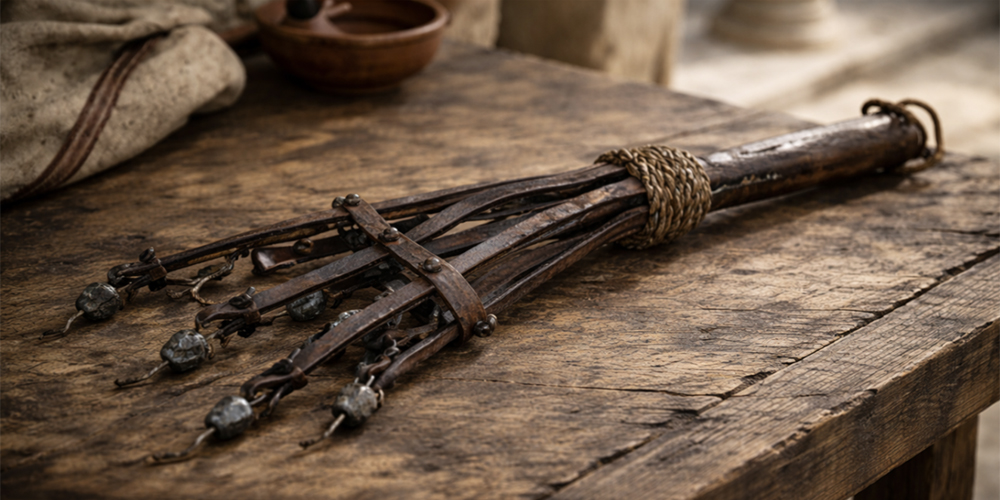
When we ask what the Roman scourge—the flagrum—looked like, we quickly discover something important: no ancient writer gives a full, technical description of the instrument itself. There is no surviving first-century manual explaining its construction, no detailed schematic preserved in Roman literature. Instead, what we have are descriptions of its effects, depictions of other Roman whips, and physical evidence from archaeology. By bringing these together, we can form a careful and historically grounded picture.
The ancient sources are clear about one thing—the severity of the punishment. Writers such as Josephus describe victims as being “first scourged” before crucifixion, while others, like Eusebius, speak of bodies being torn “down to the deep-seated veins and arteries.” These are not descriptions of a simple whip. They point to an instrument capable of inflicting deep, tearing wounds, not merely surface-level strikes. Even Roman authors like Seneca include the scourge among the most feared tools of torture, placing it alongside devices designed to inflict extreme suffering.
Yet these same sources remain strikingly silent about the exact design of the scourge. They assume their readers already understood it. For them, the horror of the scourge did not need explanation—it was common knowledge in the Roman world.
This is where archaeology becomes essential.
Excavations in places such as Pompeii and Herculaneum have uncovered Roman scourging implements that help fill in the missing details. These findings reveal that the scourge was not a single whip but often consisted of multiple leather thongs attached to a handle. More significantly, some of these thongs were fitted with small metal weights and sharp fragments, such as pieces of bone or metal.
These features explain what the ancient writers described. The weighted ends would first bruise and weaken the body, while the sharp fragments would catch and tear the flesh upon impact. What the texts describe as wounds exposing deeper tissue aligns naturally with what such an instrument would produce.
Modern historians and medical researchers have simply brought these two lines of evidence together. The written sources tell us what it did. The archaeological evidence shows us how it could do it.
So while no ancient author gives us a detailed blueprint, the combined evidence allows for a careful reconstruction:
the Roman scourge was likely a multi-thonged whip designed not just to strike, but to tear—an instrument of calculated brutality, consistent with the descriptions preserved by those who witnessed its effects.
Read a companion article: Jesus was Scourged: The Roman Flagrum
DID YOU KNOW?
(1) In scourging Romans sometimes used different kinds of torture tools. There is historical evidence that they would beat the back and chest with a flagrum, beginning with the upper part of the torso and work their way down in a in a V-shaped pattern. Sometimes they would then use reeds to then beat the arms and up the legs. There is also archaeological evidence that they might have also used a second kind of lesser whip in addition to the Roman flagrum as well.
(2) The English word “fillet,” meaning to slice, traces its origin to the Latin flagellum, the term used for this type of whip.
(3) Archaeologists have discovered skeletons of scourging victims showing fractures to the face and the top of the head, indicating blows delivered by the scourge.
(4) Sometimes scourging was sometimes seen as an act of mercy before crucifixion because it lessened the length of time the victim suffered on the cross.
(5) The Roman flagrum or scourge was NOT called a Cat of Nine Tails. This is a common misconception that is often taught in churches. The “cat of nine tails” was a whip that the British Royal Navy used during the 1700s and 1800s. It was based on the Roman flagrum but far less severe. This whip had nine ends with a knot on the end of each. It was used primarily with sailors and would leave cat-like-scratch marks on their backs. This is also most likely where people get the misconception that the Roman scourge always had nine ends. The number of ends varied. There is archaeological evidence for a three-strand flagrum but it also might have had more, even up to nine.
Keep reading below for more historical evidence of Roman scourging.
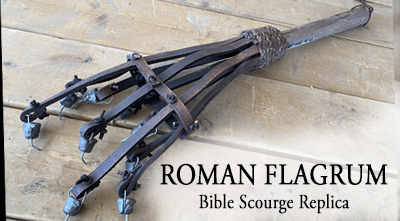
Get your own Roman Flagrum Replica. The most historically accurate replica available today.
EYE WITNESS AND EARLY CHURCH QUOTATIONS ON SCOURGING
JOSEPHUS
Jewish War 5.11.1
“So the soldiers, out of the rage and hatred they bore the Jews, nailed those they caught, one after one way, and another after another, to the crosses, by way of jest; and their multitude was so great, that room was wanting for the crosses, and crosses wanting for the bodies.”
Jewish War 6.5.3
“The soldiers, out of the rage and hatred they bore the Jews, nailed those they caught, one after one way, and another after another, to the crosses… after they had first been whipped.”
Jewish War 2.14.9
“They were first scourged, and then tormented with all sorts of tortures, before they died.”
TACITUS (Roman Historian)
Annals 15.44
“Mockery of every sort was added to their deaths. Covered with the skins of beasts, they were torn by dogs and perished, or were nailed to crosses, or were doomed to the flames and burnt…”
(Tacitus assumes scourging as part of Roman execution, though not explicitly detailed here.)
SENECA (Roman Statesman)
On Consolation to Marcia 20.3
“I see crosses there, not just of one kind but made in many different ways: some have their victims with head down to the ground; some impale their private parts; others stretch out their arms on the gibbet.”
Epistle 101 (Epistulae Morales 101.14)
“What? Do you think it is worth while to weigh down upon one’s own shoulders punishments which even the most wretched criminals shrink from—the rack, the cord, the scourge, the stake?”
HORACE (Roman Poet)
Epodes 4.3
“Horribile flagellum.”
Translation:
“The terrible scourge.”
PHILO OF ALEXANDRIA
Against Flaccus 83–84 (expanded context)
“They were scourged, and after they had been subjected to every kind of insult and outrage, they were crucified.”
Embassy to Gaius (Legatio ad Gaium 302)
“Men were scourged, tortured, and subjected to indignities, though they had done nothing wrong.”
EUSEBIUS (c. 260–339 AD)
Ecclesiastical History 4.15
“For they were so torn by scourges, that their very veins and arteries were laid bare, and the inward parts of their bodies were exposed to view.”
Ecclesiastical History 5.1 (Martyrs of Lyons)
“They endured such barbarous treatment that it is impossible for us to describe the multitude of their sufferings… their bodies were covered with wounds and bruises, and torn open by the scourges.”
JUSTIN MARTYR (c. 100–165 AD)
Dialogue with Trypho 97
“For they who have recorded all that concerns our Savior taught that He was scourged, and that He suffered those things which were predicted by the prophets.”
ORIGEN (c. 184–253 AD)
Against Celsus 2.16
“Jesus, having been scourged, was led away to be crucified.”
TERTULLIAN (c. 155–220 AD)
Apology 21
“The flesh of Christ was torn with scourges.”
CLEMENT OF ALEXANDRIA (c. 150–215 AD)
The Instructor (Paedagogus) 2.8
“The Lord Himself suffered, being scourged and dishonored, and enduring all things for our sake.”
CYPRIAN (c. 200–258 AD)
Treatise 9 – On the Lapsed
“He was scourged, that He might redeem us from our sins.”
Follow Us:



Share these resources:


